Thursday, October 18, 2012

Like a splinter or like a journalist

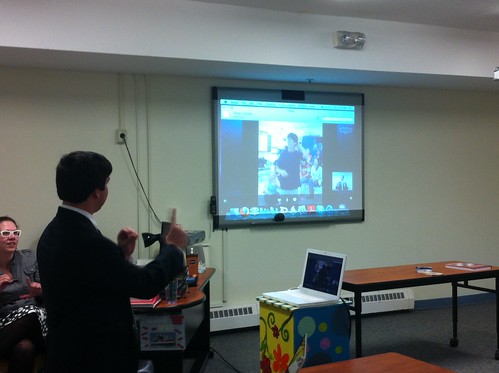
Last night I had the honor of spending some time (via Skype--thank you all for your patience with my technical difficulties!) with a group of school librarians in Nebraska talking about embedded librarianship. The slides from my talk are below.


Embedded school librarianship - NEMA from formanlibrary

It was a wonderful opportunity to talk about the why and how I've embraced the sometimes messy process of becoming a more embedded librarian. As I talked about in my presentation, I believe that embedding ourselves in different teaching and learning spaces is the natural evolution of the collaborative efforts that have been at the heart of our profession for so long. 

Monday, October 15, 2012

Fight in the Dining Hall: A Research Allegory

I know it's been quiet here on the blog--it's been a busy fall in many ways. But tonight I finished a project I've been thinking about for a while, and I wanted to share.

When I talk to students about research, I always talk about trying to get as close to the original source as possible. This often comes up in discussions about Wikipedia, when I point students to the Reference list at the bottom of articles (which few of them had noticed before). The analogy I usually use is to explain that research works kind of like gossip--the story can get distorted the farther you get from the original source. I often create a version of the story depicted below involving students in the class. Using the gossip analogy has often helped students grasp the "get to a primary source" idea.

I'd been toying for a while with the idea of creating some sort of video to illustrate the story, but I don't have a lot of film making expertise. But as I was playing with apps for some different projects, I had an "aha!" moment about how I could make this project.

I used Skitch (to make the drawings) and Explain Everything (to create the video) on my iPad to make the video. I can't decide if it's nerdtastic, or the most nerdtastic thing I've ever made, but I'm pretty happy with how it came out.


Sunday, August 12, 2012

Sweat, Tears, or Sea

“The cure for anything is salt water: sweat, tears or the sea.” – Isak Dinesen


The last school year involved a fair amount of both sweat and tears. At one point it was suggested that every time I cry at work I should get a pedicure; I am many pedicures behind.

In starting to write this I was hesitant to admit that sometimes I cry at work; I know some people will think that it makes me seem weak or unprofessional. I was getting ready to write a justification, but then I remembered that it's okay to cry:


Anyway, this summer I have been lucky enough to spend some time on the sea, which I think is the most powerful salt water cure.

There is something about standing in the ocean that makes me feel both insignificant and powerful. Insignificant because I am just this small, small person on the edge of a vast, unknown territory. Powerful because despite being up against something bigger and infinitely stronger, I manage to keep my head above water.

I usually first stand in the water facing out, so I can anticipate and react to the waves. But as I get my "sea legs" I turn and face the shore, letting myself be carried by the waves. I gradually trust in my ability to react to the waves even though I can't always see them. And if sometimes I get a face full of water? Oh well.

The ocean, like so many challenges we face, is huge and beyond our direct control. And while I find that frustrating in my work life, it is one of the things that makes the ocean so beautiful.

So much is beyond our control; sometimes we just have to trust in our ability to ride the wave, and keep our head above water. And even if we don't manage that all the time, it's just a little salt water, and we can prepare ourselves for the next wave.

Early on in the summer, I spent a day in Gloucester with some friends. While we were wading on the beach a little boy approached the edge of water. He was all limbs and belly, and watching him move I thought, "Ah, that's why they're called toddlers." And he loved the water. He moved as fast as he could get his legs to carry him straight towards the ocean. And, inevitably, fall either forward or backward onto the sand. And then immediately get up and charge full-speed ahead once again. Sometimes he'd start charging in the wrong direction, but as soon as he figured out he was no longer headed towards the water he did an about-face and headed towards the water once again.

I loved watching him approach something so big and so unknowable with such enthusiasm and joy; I loved that the last thing he wanted to do was turn away from a challenge.

The analogy became clear to me in one of those moments that I believe is only possible while standing in the ocean. There are challenges to face, but there are also forces larger than myself in play. I can run, full-speed, arms open to the challenges this year will bring; but that doesn't mean I have the power to control them all. I sometimes I wish I could choose which challenges I want to face, but then they're not challenges. You can't pick which waves come to shore.

And I was reminded, too, that I love the challenges. I can approach challenges with joy and with enthusiasm--even if the end result is a face full of salt water. That's all part of it.

This summer has been, very deliberately on my part, a time of reflection. I hope, as what promises to be another busy year gets underway, that I remember the sea, and that no matter how overwhelming things may seem, I can still stay on my feet.

With your feet in the sand, it doesn't matter what state your pedicure is in

Sunday, June 17, 2012

Figure/Ground

I was recently in New York City for the SLJ Day of Dialogue. I love going to New York, but I also find it overwhelming. I have lived most of my life in rural areas, and I spend so little time in cities (especially big cities) that I often feel a bit of sensory overload.

However, I had an "ah ha!" moment while walking around Sunday afternoon--I find New York overwhelming because, for me, it is all figure, no ground.

I'll admit I have a very basic understanding of figure-ground organization (I had to look it up to make sure I had the right terminology for my insight), but the easiest way to understand it (at least in the way I'm using it) is in optical illusions like the Rubin Vase. An observer can either see it as two faces in profile, or a vase. The definition of what the image is depends on the interpretation of the observer, not on the image itself. Again, I am not an expert in this; it's just the analogy that helped me make sense of my experience.


For some reason, thinking about how overwhelming my current surroundings were brought to mind a (for me) completely opposite experience. This was many, many years ago--if I had to guess, I'd say I was in middle school. Some of my cousins were visiting our house in upstate New York. I grew up in the Adirondacks, surrounded by fields and mountains, with our "next door" neighbors about a tenth of a mile down the road. A few of my cousins--most of whom lived in the suburbs--were visiting, and they were absolutely fascinated by the cows that lived in the field next to our house. And all I could think was, "What's the big deal? They're just cows; they smell and they attract flies."

For me, the cows were ground; for my cousins, they were figure. For me, everything in New York City was figure; for everyone around me, it was mostly ground.

As I was thinking about and contrasting those two experiences ("so many people! so much to look at! so many sounds/smells/sights!" vs. "what's the big deal, they're just cows"), I started wondering if there are professional conversations in which we've made things ground that really need to be figure--or are making things figure that really should be ground.

Kristin Fontichiaro's recent blog post What Admins Think of Librarian Messages highlights a perfect example of what I'm talking about. Maybe our advocacy efforts aren't as effective as we like not because our messages are being ignored; maybe the messages are being heard, but they're not the right messages.

I wonder, too, if it goes deeper than that. Are there situations in which we've made "the problem" ground, when it's really still figure? When we meet failure in our advocacy efforts, are we staying with the same definition of the problem even though the reason we've met failure is because we're trying to solve the wrong problem? If we've misidentified the problem, there is no chance of identifying the right solution.

On a different level, I wonder how much these figure/ground (mis)perceptions affect our teaching. I don't think we do this consciously, but many teachers (and I include myself in this) often make the process of learning ground, when for many students it is still figure--or, worse, the students have made it ground without actually having a solid understanding of the learning process and themselves as learners. This can range from the "good student" who has become adept at absorbing information and returning the "right" answers at the right time to the "bad student" who has given up on themselves as a learner because this process that seems to come naturally to others--which their teachers don't teach explicitly, further reinforcing the idea that students should naturally know how to do it--does not come naturally to them.

I hear again and again from teachers, "I don't have time for XYZ skill, I need to cover more content." We have, in many ways, made content figure, while keeping the process of learning ground. But is that what education is about? We tend assume (particularly as students get older) that the process of learning is ground for our students, that they have well-established habits of mind. But this is not necessarily true--and even if students have mastered the process of learning when they're younger, as brains mature they become capable of different kinds of thinking. And, as with any truly valuable and complex skill, learning takes practice. If you'll excuse the pun, by assuming that the process of learning is ground for our students, we may be building on a weak foundation.

I also wonder how figure/ground (mis)perceptions impact our teaching of technology. I know many teachers (of all ages) who assume that students just naturally know how to use technology of all kinds effectively. Students may have grown up around these technologies, but that does not mean they have any natural, innate ability. We all grew up around books and print, but I don't know of any "print natives" who had a natural, innate ability to read just because they grew up around books. Letters, words, and their meanings had to be raised to figure for all of us to learn to read. We need to help students raise the technology they're surrounded by from ground to figure in order for them to learn to be thoughtful, effective users of the tools available to them.

The same goes for all sorts of skills--just because a student is good at hanging out with friends does not mean they intuitively understand how to effectively collaborate.

For some of us, these skills have been ground for us for so long that we forget that they used to be figure for us. This is a big part of why I think ongoing learning is such a vital part of being an effective teacher--it makes it easier for you to stay in the mindset of your students, and remember how challenging the process of grappling with new information can be.

It's important for us to step outside ourselves and make a conscious effort to move our assumptions--about all kinds of things--from ground to figure. If we don't try and see things from another point of view, we risk losing all perspective.

Sunday, May 6, 2012

Relentless Optimism

Maybe it was Caine who inspired me. I know this video has made the rounds, but if somehow you haven't seen it, take the time to watch it. And if you have seen it, watch it again (the fun pass really is an incredible deal).


There are other reasons, too, but I'm not going to get into them, as many are deeply personal, and that's not the point of this post.

Whatever it was, a few weeks ago I posted the following status update on Facebook:


It was, to be honest, kind of a lark. But somehow--in a way and for reasons I don't think I'll ever fully understand--the idea of "relentless optimism" caught on at my school. A few colleagues "liked" my status, some mentioned it to me. . . and I also started talking about relentless optimism, and shouting "relentless!" when I felt myself getting pulled into negativity. And then other people did, too.

I accidentally started a movement.

And as the accidental leader of this movement, I feel like I should be able to explain what it's about. So I'm going to try, with the disclaimer that my ideas about relentless optimism are evolving every day--in ways driven largely by conversations I'm having with colleagues and friends.

So what is relentless optimism about?

It's about believing in (and working for) the possibility of change despite evidence to the contrary. It's about believing that we're all in this (whatever "this" is) together. It's about moving forward, even when moving forward is frustrating and difficult and overwhelming and seemingly pointless because it feels like you've never gotten anywhere before (or even lost ground).

It's not about being delusional or ignoring problems. It is so NOT about that. It's easy to just pretend that everything's fine--easier still to simply complain about what's wrong and not do anything about it. Relentless optimism is about hope--and hope makes you vulnerable. It involves the potential of feeling let down--or feeling like you let someone else down. And that can be scary. But it's better than feeling stuck.

If you don't try, you are almost guaranteed to feel disappointed. If you try, and things don't work the way you wanted them to, you might still feel disappointed, but at least you'll know you tried. It can be easy--and comfortable--to succumb to negativity and defeatism. Relentless optimism involves risk; it can mean working without a net. It might not feel safe, but it's exhilarating.

And it's hard. It's exhausting. But it's worth it. And surrounding yourself with people who are on the same page is not just important, it's vital.

Relentless optimism is about being part of a team and being inspired by colleagues. The work we do is hard, but it's easier when you know you're not the only one; one of the best parts of the past few weeks has been when a friend or colleague will (seemingly randomly but it always seems to come at just the right moment) e-mail me or text me the word "Relentless!"

It's important to surround yourself with passionate people; it doesn't even matter if you share the same passions. Passion, like negativity, is contagious. So surround yourself with people who inspire you. And if you can't surround yourself with them (because we all have to deal with people who suck the energy right out of you), make sure you spend time talking with them, focusing on them, finding out what they're doing. It sustains you. Well, I know it sustains me.

The work we do is hard, on every level. It’s harder still if we don’t believe we can make a difference. And feeling like we're all in this together helps.

It's about, as Plato put it, being kind, for everyone you meet is fighting a hard battle. And don't forget that "everyone" includes you--be kind to yourself. Indulging in hope is kind to yourself. Surrounding yourself with people who inspire you is kind to yourself. Taking a night off is kind to yourself, and makes the rest of life possible. Acknowledging that you're struggling and asking for help is kind to yourself. 

Relentless optimism is about taking the long view. Even when you feel like you're shouting into the void, you have no idea when the echoes will bounce back. There are projects and ideas that I’ve been talking about for what seems like forever, and I was giving up hope on ever getting traction on them. And now, all of a sudden (but not really all of a sudden), things are happening. People are responding. Relationships I’ve been cultivating for years are transforming into partnerships.

It's about not waiting for someone else to be the leader. No matter our position, we can all be leaders. There will always be other people and other factors that influence the direction of your work, but to cede all the decision making to other people is neither relentless nor optimistic.

Being optimistic (and being relentless) is a choice. It's not always the easy one. But the more often and more deliberately I make it, the easier and more powerful it gets. And I love watching people around me make that choice, too. Relentless optimism does not happen in a vacuum.

And relentless optimism is about so many other things, too. It's about whatever it needs to be about for you.

And optimism is, maybe, the wrong word. Maybe it's more about relentless momentum (which doesn't really have the same ring to it). Forward motion gives me hope. Acknowledging the struggle is optimistic because it means you believe that something can be done. Believing in the possibility of change is the most optimistic thing I can think of. And if you're in education and you don't believe in the possibility of change, I'd like to kindly ask you to get out my profession.

And, perhaps most importantly, it's about yelling "relentless!" at seemingly random moments. As a reminder to yourself, as a reminder to others, and because it adds a little levity. And levity is important.

Because every movement needs buttons


Sunday, April 22, 2012

Things that make me love my job

I'm working on a few big ideas that I've been meaning to write about, but can't seem to make the time and brain space to write about them in the way I want to. It's been a particularly exhausting few weeks, and a time when it's been easy to focus only on what's not working and all the work still left undone. But on my walk this morning (after a glorious nine hours of sleep) I was thinking about some of the projects I've been working on in the last week or two, and realizing that while I am, at times, legitimately frustrated and discouraged, I do have a lot of things to be grateful for.

1) Signing with Texas

When I was at Computers in Libraries in DC, I heard Carolyn Foote speak about how teachers in her school were using iPads in their classes, and she mentioned how her school's sign language teacher was using Skype and FaceTime to connect to other schools. My ears immediately perked up; there aren't a lot of schools with ASL programs, but we have one--and a teacher who I thought would love the idea of connecting with another school. And I was right! Last Thursday the two classes Skyped, and I have no words for how awesome it was to watch these two groups of students connect.

L pass O
Learning the sign for El Paso


2) My students

Friday was the Day of Silence. I was at breakfast Friday morning handing out buttons to student participants, and ribbons and stickers to supporters. Of the 100 buttons we got last year, I had over 50 left over, so I didn't get any new ones this year. But I ran out of buttons, which is the best "problem" I could possibly imagine. I think I had about 70 ribbons, and now I only have two left. My first year here, one student participated in the Day of Silence. To see so many students from diverse social groups take a visible stand for the type of school they want to have gives me "hope for the future" warm fuzzies.

3) Momentum

I've been given the go-ahead to start planning some edcamp-style PD for our school, which is something I've been wanting to do for a while.

4) My colleagues, both near and far

In a year that's been incredibly busy, exhausting, and at times frustrating, I am incredibly grateful for the support and friendship of my colleagues. I am thankful that Twitter and Facebook and this blog and conferences and so many other opportunities have allowed me to connect with colleagues from all over the country. Those connections are invaluable to me both professionally and personally, but I am most grateful for the colleagues at my school who are "in the trenches" with me on a daily basis.

I am given almost daily reminders of how incredible the people I work with are. Their innovation and creativity and passion inspires me. I am so lucky to work with so many amazing people, and so grateful that they seek me out to share what they're doing in their classrooms.

As I've been struggling with some challenges in the past few weeks, they have been there without fail encouraging me, acting as a sounding board, and letting me know that they believe in me and in what I'm trying to accomplish. If you are one of those people (and I hope you know who you are), thank you. So much.

5) Optimism

Last week, half in jest, I posted that having examined the available options,  I had decided on relentless optimism. Mostly this has consisted of yelling the word "relentless!" every time I or anyone around me starts succumbing to negativity. It is ridiculous. But, I swear to you, it works. Both as a reminder to stay optimistic, and as a way to bring levity and stop the slide into dwelling on what's going wrong. I'm not quite ready to write a self-help book based on this experiment, but I highly recommend it.

Sunday, April 15, 2012

"Do you ever come in here?"

We've just finished up Family Weekend at my school, a marathon two days of parent-teacher conferences and other events. Since I'm not a traditional classroom teacher, I only have a handful of formal conferences. I spend most of my time chatting with parents and directing them towards the right teacher's classrooms.

Fairly often during the weekend (and this has been true of every Family Weekend I've been here for) a parent will wander into the library with their student, and ask some variation of, "Do you ever come in here?"

It is usually not an idle question.

And regardless of how often I actually see the student in the library, I never blow their cover. Because most often the question is not really about how often they come to the library--it's about how serious a student they are. Serious students go to the library. And if that's the perception the student wants their parents to have of them--if that's the perception the student wants to have of themselves--I am more than happy to go along.

Do I think it's true that serious students go to the library? Yes. And no. I see very serious students who rarely come to the physical library, and not-so-serious students who are in there all the time. But there is, undeniably, a larger cultural image around library use and being "smart."

My thinking about librarianship and library as place has been shifting in very significant ways over the past few months. But this weekend reminded me that ours is not the only image we need to consider as we talk about the changing role of librarianship.